He said that if there are issues that need to be talked about, it is between India and Pakistan.

Had India agreed to join the trade pact, Indian markets would have been flooded with cheap Chinese products.

Indonesia is not even counted as a next-door neighbour of India, though the southern-most tip of India is less than a hundred miles away from the northern-most tip of Indonesia. Bringing Indonesia back in the mainstream of the Indian strategic calculus is a step long overdue, says Dr Rahul Mishra.

Prime Minister Malcolm Turnbull's first State visit to India is an indication of the success of India's Act East Policy, says Dr Rahul Mishra.

Chinese President Xi Jinping has suggested five thrust areas to improve relations with India. It is likely all these issues, in addition to the points raised by Xi at Fortaleza, will be part of the joint declaration at the end of his visit to India, says Srikanth Kondapalli.
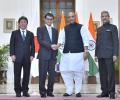
The India-Japan 2+2 dialogue added strategic heft to the special relationship in the wake of growing Chinese assertiveness on regional affairs, points out Dr Rajaram Panda.

The new government needs to clearly insist on diplomatic reciprocal arrangements with China. While reciprocity is a function of power in bilateral relations, the Modi-led government's responses should be based on India'S inherent strengths, says China expert Srikanth Kondapalli.

Indians at large harbour a notion that their country is cherrypicking out of the American basket of goodies, but the policymakers in Delhi and the political leadership are well aware that it can only be a pipe dream since a military alliance with a superpower is a profound irrevocable commitment, observes Ambassador M K Bhadrakumar.

The USS John Paul Jones acted like a dog marking the lamp post, observes Ambassador M K Bhadrakumar.

India cannot choose its geography and devise regional strategies to dovetail into the Western Indian Ocean hypothesis conceived in the Pentagon, argues Ambassador M K Bhadrakumar.

'India enjoys the maneuverability of a coming big power.' 'It is this possibility that has persuaded Moscow to humour India and stayed Washington from getting punitive about India's neutrality on the Ukraine issue.'

'The US-India relationship is in a different league altogether,' Obama administration officials tell Aziz Haniffa/Rediff.com in Washington, DC.

'The big power struggle in faraway Europe erupted at a most critical juncture when India has been increasingly sceptical about American policies and statesmanship,' argues Ambassador M K Bhadrakumar.

India's largest airline has also told its crew members -- who are working on flights connecting India with East Asian countries like Thailand and Singapore -- to wear N95 masks at all times when they are on ground.

The India-Japan joint naval exercises are a strategic signal for China, observes Dr Rajaram Panda.
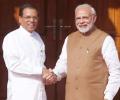
'Modi's first foreign trip at the very outset of his second term as PM reinforces a growing impression that this regional tour underscores a shift in emphasis in India's foreign policy that was traditionally focused on the northern tier of countries to the Indian Ocean rim,' explains Ambassador M K Bhadrakumar.

'Even as discord over US-India trade and commerce colours diplomatic relations, defence relations between the two countries remain on a firm footing,' points out Ajai Shukla.

The 2 countries signed 15 agreements including one on defence cooperation after Prime Minister Narendra Modi held 'productive discussions' with President Joko Widodo.
'Both India and Pakistan are now, for the first time in history, very closely allied and connected with the US -- economically and politically.'

'Clearly, from the Indian viewpoint, the US retrenchment from Asia cannot be happening as good news.' 'The abandonment of the US' pivot to Asia exposes the US-Indian partnership to be a mere transactional relationship,' says Ambassador M K Bhadrakumar
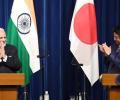
'Relations between India and Japan are robust and devoid of either shadow of history or any irritant.' 'In fact, there is plenty of warmth and goodwill earned over history. There are no negatives but only opportunities,' notes Dr Rajaram Panda.


'This is the first time the US has formally recognised the threat India faces from terrorist organisations based in Pakistan.'

Modi knew in his heart that India does not have the financial muscle to support the new bank with offers of co-financing international projects, something China can do from the bank's base in Shanghai. If established in Mumbai, it may have employed a few Indian bankers and satisfied the national ego but there was little financial value to be drawn from it.

From early indications, the Modi government's foreign policy seems to be pragmatic and reciprocal, says K G Suresh.

'There is no Buddha or Gandhi among countries, existing for the service of others; they all exist for the good of themselves.' 'For each country, its own interests should be paramount, and it is futile and churlish to expect China to be an exception to this rule,' says B S Raghavan, the distinguished civil servant and long-time China-watcher.
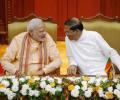
'What we have heard from the Sri Lankans is their desire to have a foreign policy that allows Sri Lanka to best advance its own interests rather than a foreign policy that relied solely on one relationship.' 'We think this is an attitude that makes a lot of sense. India and Sri Lanka have many areas of shared interests, and it's certainly welcomed by us to see that deepening of those ties.'

'Alas, the Congress party offers no suggestions as to how to unscramble the omlette it cooked during 2004-2014 on which the Modi government may have since lavishly spread some tomato ketchup,' says Ambassador M K Bhadrakumar.

In bilateral interfaces relations with China have also to be given due weight, opines Premvir Das

'If, as appears to be the case, India is on way to 'mending fences' with China, and China is equally desirous to 'reset' the relationship, this could be a self-reflexive moment in India's positioning vis-a-vis not just the Dalai Lama, but also the Tibetan issue and China as a whole,' points out China expert Alka Acharya.
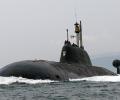
'We have been found seriously wanting in addressing our undersea warfare capability and China's emergence is a cause for concern.'

The administration and America Inc have invested in Narendra Modi's power to transform India. Aziz Haniffa/Rediff.com reports from Washington, DC.

The Security Council as it is today is unable to bring peace and security in the world and so there is reason for countries like India to become members of the Council, Ambassador Asoke Kumar Mukerji tells Sheela Bhatt/Rediff.com.

This is the joint statement issued by the ministry of external affairs on the visit of US President Barack Obama to India.
